
Jasmine in perfumery
Originally from India but widely cultivated in Egypt, this white flower with five star-shaped petals lies at the heart of many great masterpieces of perfumery… and naturally in several of our creations, because some of you are deeply fond of it and selected the
Jasmin Grandiflorum
🤏 Very fragile, the flowers are picked by hand before or just after sunrise, generally between summer and early autumn. They are processed quickly in order to preserve their quality.
Solvent extraction produces a concrete, a waxy substance that is then washed with alcohol to isolate the fragrant components and obtain an absolute, usually dark orange in colour.
💶 The yield is extremely low: depending on the harvest and cultivation conditions, it generally takes between 700 and 1000 kg of flowers to obtain 1 kg of absolute.
👃 Jasmine grandiflorum absolute reveals a rich and nuanced profile: luminous floral facets, fruity and green nuances, sometimes slightly spicy.
It naturally contains indole, which brings depth and a subtle animalic sensuality, although this facet generally remains fairly discreet within the overall balance of the flower.

Jasmine Sambac
This flower, whose corollas often display six to eight petals, is cultivated in India, China and several regions of Southeast Asia. It has inspired both perfumers and pastry chefs.
🤏 As with grandiflorum, the flowers are picked by hand very early in the morning. In many growing regions they are harvested at the bud stage, allowing the flower to open during the day while preserving its fragrance.
The extraction process is the same: the flowers are treated with a solvent to produce a concrete, which is then washed with alcohol to obtain jasmine absolute.
💶 The yield is of the same order of magnitude as for grandiflorum and depends greatly on the harvest.

Olfactory perception
Both species naturally contain indole, but their olfactory perception differs.
Jasmine sambac is often perceived as more solar, warmer and more opulent.
Its indolic facet often appears more pronounced, giving the flower a more sensual, sometimes slightly animalic character. Green and fruity nuances can also be perceived, which some people compare to banana peel or tropical fruits.
This more indolic impression is mainly related to olfactory perception and the overall balance of molecules, rather than to a systematic difference in indole concentration between the two species.
A personal jasmine
What makes bespoke creations so fascinating is the way a simple note such as jasmine can evoke an entire world of memories, images or dreams.
Behind every mention of “jasmine” in a brief lies an intimate interpretation: sometimes connected to a real flower, sometimes to an impression, an atmosphere, a place, or even a person. And that interpretation becomes an ingredient in its own right in the creation of the perfume.
Jasmine perfectly illustrates this process. Many people cannot distinguish grandiflorum from sambac, yet they know precisely what they want to evoke. It is not the variety that matters, but the emotion it carries.
Exploring these memories, putting words to the sensations, the settings and the moments associated with this flower allows us to build a fragrance that feels right, faithful to what one wants to express.
There is not a single jasmine, but as many jasmines as there are memories.
The Jasmine Illusion
✨ To evoke a jasmine that feels true to your world, we use both natural absolutes, Grandiflorum and Sambac, but also a palette of molecules chosen for creative reasons (and sometimes budgetary ones), which extend or reinterpret its facets.
▷ Benzyl acetate
A soft, fruity floral note, slightly balsamic, which brings roundness and fluidity to the accord.
▷ Hedione
A transparent, fresh, airy and slightly green note, essential for diffusion and the sensation of moist petals.
▷ Indole
A natural component of jasmine, essential for its realism, with animalic, sensual, almost musky touches.
▷ Methyl anthranilate
A smooth, floral note with a slightly almond-like nuance, reminiscent of a creamy orange blossom.
▷ Hydroxycitronellal / Florhydral
Molecules often associated with lily of the valley, which can bring floral freshness and help structure a jasmine accord with watery and slightly soapy nuances.
… and many others, which we carefully select depending on the olfactory universe you wish to explore in your jasmine-based creation.
Jasmine in Superfumista perfumes
In our collection, jasmine is used in the formulation of two of our creations.
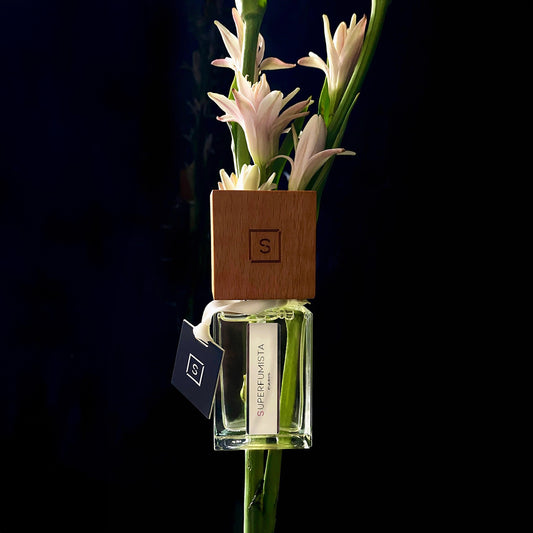
Tuberotic features a tuberose on a stem supported by a complementary Grandiflorum jasmine and notes of black tea.
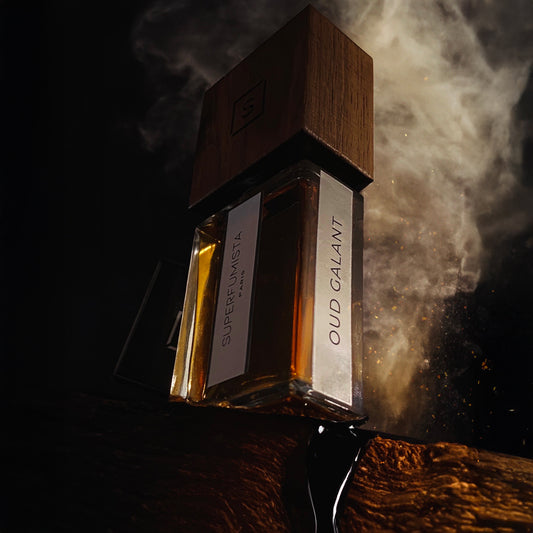
Oud Galant where the absolute of Grandiflorum jasmine from India brings a floral touch that is both characterful and delicate to the woody and smoky facets of Siam Oud, also softened by notes of iris and violet.